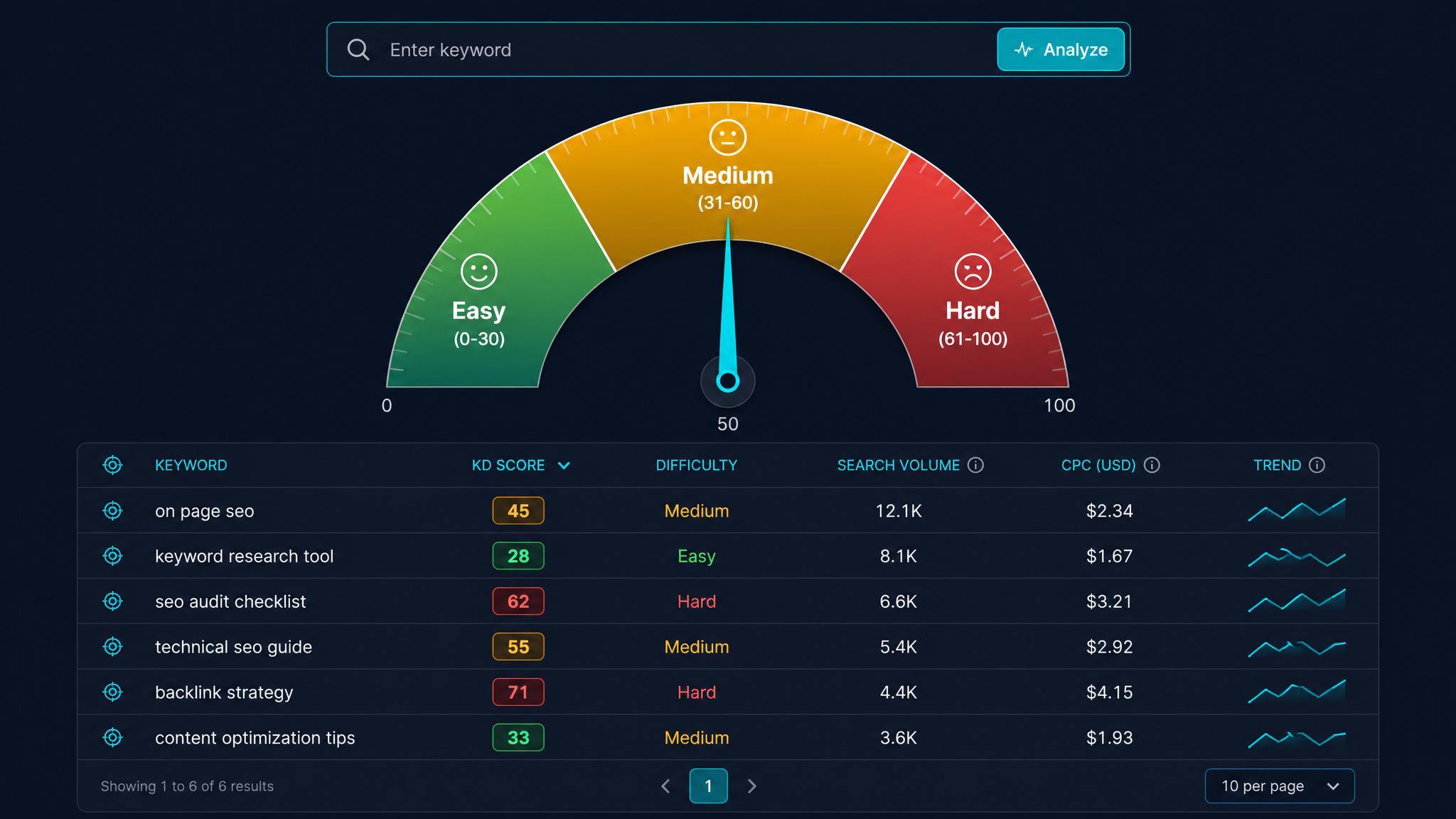
Keyword difficulty. Sounds like the kind of term an SEO consultant drops at a dinner party to sound clever, right? But here’s the thing: it’s basically a traffic light for your content plans. Ignore it, and you might as well be racing a Formula 1 car on a pushbike track.
Let’s cut through the jargon:* Keyword difficulty is a score (usually between 0 and 100) that tells you how tough it’ll be for your website to land on page one of Google for a specific search term.A score of 10? Almost a walk in the park. A score in the 90s? Might as well try entering the Olympics with your local pub quiz team. Most tools even colour-code them so you can spot the easy wins (green), middling challenges (yellow) and SEO Everest climbs (red) at a glance.
Why should you care? Simple: it saves you from pouring your heart into an epic blog post about "best CRM software" (difficulty 80+) only for it to sink without a trace. Meanwhile, “best CRM software for freelancers on a budget” (difficulty 30–40) is more like a Sunday league match—you stand a chance of actually winning.
Keyword difficulty is your pitch inspection. It tells you who you’re really up against, so you don’t bring a butter knife to a swordfight.
Bet you didn’t realise: no SEO tool has a backdoor to Google’s secret ranking algorithm. Instead, they make educated guesses—like weather forecasters, but for SERPs. Still, they’re surprisingly accurate most of the time.
Here’s what most tools look at:
Domain authority of the top sites – If it’s all Forbes, Wikipedia and household names hogging the first page, the score rockets. If Bob’s Plumbing Blog is up there, you’re in with a shout.Backlink count and quality – Loads of strong backlinks to the top results? That’s a moat. Fewer backlinks? Easier to wade across.Content quality and depth – Is the top content wafer-thin, or does it read like an encyclopaedia written by Hermione Granger? More depth, more difficulty.SERP makeup – Paid ads all over the shop? Or loads of featured snippets? These shake up the calculation (and your odds).Search volume – High search numbers usually mean higher competition.Domain-level SEO signals – How old are these top domains? Are they digital dinosaurs or fresh faces? Big sites with hundreds of pages and tons of traffic make life harder for newcomers.After crunching all that, you get a neat little score. KeywordNumbers and most other tools peg it from 0 (push over) to 100 (steel cage match with Google’s favourites). Every tool has its quirks, but they’re all roughly in the same ballpark.
Key point:* Keyword difficulty isn’t gospel. It’s more like the weather forecast—usually helpful, sometimes a bit off. Sometimes a plucky new site with killer content can sneak in where they “shouldn’t”. Always eyeball the SERP yourself before committing to months of work.Reading the Keyword Difficulty Score (0–100): What Those Numbers Actually Mean
Time for a field guide. Here’s how to read the score, with proper examples (not just theoretical nonsense):
0–20: Very Easy
These are the low-hanging fruit. New sites, tiny blogs, or startups can grab these with a bit of elbow grease.
What to expect: Fastish rankings (4–12 weeks), not much backlink arm-wrestling required, a SERP that looks beatable.Example: "How to use Notion templates for freelancers" (difficulty 15–20). If you’re a freelancer or niche blogger, this is your home turf.Who should go for it: Newbies, side hustlers, small businesses dipping their toes into SEO.21–40: Easy
Still very doable, especially if your site isn’t a digital newborn anymore.
What to expect: Ranking in 8–16 weeks if you play your cards right. Some backlinks needed, but nothing soul-destroying.Example: "Best project management tools for nonprofits" (difficulty 30–35). If you can write a thorough guide, you’re in the game.Who should go for it: Early-stage sites with a bit of substance, marketers building authority, sites in punchy niches.41–60: Medium
Now it’s a proper contest. You’ll need decent content AND some SEO muscle (think: backlinks, a bit of domain clout).
What to expect: 12–24 weeks to see daylight, need multiple backlinks, and you can’t phone in the content.Example: "Content marketing strategy for B2B SaaS" (difficulty 45–50). Good for established sites with some oomph.Who should go for it: Sites with 6+ months of solid output, willing to get a few backlinks in the mix.61–80: Hard
You’re now in big brand territory. Ranking here is like trying to get a table at the fanciest restaurant in town—without a reservation.
What to expect: Six months (or much longer). You’ll need top-tier content, serious backlinks, and a good reputation with Google.Example: "Best email marketing software" (difficulty 75+). If you’re not already a known player, prepare to work.Who should go for it: Well-known brands, established sites with a loyal following, those with something genuinely special to offer.81–100: Very Hard
This is Everest. The SERP is a Who’s Who of the internet. New sites need not apply—unless you’ve got a digital rocket ship stashed somewhere.
What to expect: Extremely tough, even with all your best tricks. Reserved for the household names and giant publishers.Example: "Best CRM software" (difficulty 85+). Think: major review sites and SaaS behemoths.Who should go for it: Only if you’re a major brand or have a serious ace up your sleeve.Keyword Difficulty vs. Search Volume: How to Find the Golden Zone
Here’s what most people miss: it’s not just about difficulty OR volume—it’s the combo that matters. Like chocolate and peanut butter, the magic is in the mix.
Example 1:*Keyword: "Email marketing software"Difficulty: 85Search volume: 50,000/monthIf you’re a powerhouse, this is a gold mine. For a new site? You’ll need more than hope and a prayer.
Example 2:*Keyword: "How to build email list with lead magnets"Difficulty: 35Search volume: 800/monthNow we’re talking—solid search volume, realistic competition. Much better odds for a smaller, scrappier site.
The sweet spot:* Difficulty 20–50, search volume 300–3,000/month. That’s the SEO equivalent of finding a pub with great beer and no queue at the bar.Here’s a cheat sheet to help you prioritise:
| Difficulty | 500+ searches/month | 100–500 searches/month | Under 100 searches/month |
|---|
| 0–30 | 🎯 IDEAL | GOOD | Marginal |
| 31–50 | GOOD | 🎯 IDEAL | Marginal |
| 51–70 | Worth trying | GOOD | Skip |
| 71+ | Only if you have authority | Worth trying if niche | Skip |
What Keyword Difficulty Should You Chase? (It Depends How Old Your Site Is)
Not all websites are built equal, and your age does matter here (at least online).
Brand New Site (0–3 months)*Target difficulty: 0–20You’re crawling, not sprinting. Build a foundation, get some early wins, keep expectations realistic.Developing Site (3–12 months)*Target difficulty: 20–40You’ve got some content and Google knows your name. Time to level up, aim for small-to-medium fish.Established Site (1–3 years)*Target difficulty: 30–60Now you’ve got some muscle. Go after medium-difficulty keywords and flex that backlink profile.Authoritative Site (3+ years)*Target difficulty: 40–80You’re the wise old owl. You can go after the big game now. Use your existing clout to push into tougher territory.Heads-up:* This is a guide, not a rulebook. If you’re producing world-class content and building smart backlinks, you can punch above your weight. But in general, play it safe and grow into the big leagues.5 Rookie Mistakes with Keyword Difficulty (And How to Dodge Them)
1. Ignoring Difficulty Altogether
You pour your soul into a keyword with a difficulty score of 85, then wonder why it’s invisible. That’s like bringing a rubber dinghy to a yacht race.
Fix: Always check the score before* you start. If it’s out of your league, pick a battle you can win.Sometimes the tool says “easy”, but the first page is all giants. Algorithms make mistakes too (shocking, I know).
Fix:* Always eyeball the top 10 results yourself. Thirty seconds of SERP snooping can save you months of wasted effort.3. Only Chasing Zero-Difficulty Keywords
Easy keywords might be a doddle, but if they only get 50 searches a month, you’ll struggle to get meaningful traffic—or to impress your boss.
Fix:* Balance is key. Sometimes a slightly tougher keyword with real volume is the true prize.4. Low Difficulty ≠ Easy Money
You might rank for an easy keyword… then realise nobody searching for it is actually looking to buy.
Fix:* Check search intent. Sometimes, a tougher but commercial keyword is worth the extra effort.5. Forgetting Your Site’s Strength
A 2-month-old site going after difficulty 50+ keywords is a bit like a toddler challenging Mike Tyson.
Fix:* Match your targets to your site’s real authority. Start small, build big.How to Plug Keyword Difficulty into Your Content Plan
Here’s your playbook:
Build your keyword list – Gather 20–50 good targets in your niche, complete with difficulty scores.Sort by difficulty – Split into easy (0–30), medium (31–50), and hard (50+). No need for a spreadsheet-induced migraine.Phase your attack:Phase 1 (Months 1–2): Go for the easy wins. Bag some rankings, build authority.Phase 2 (Months 3–5): Tack on medium-difficulty terms. Now you’ve got some gravitas.Phase 3 (Months 6+): Take a swing at the hard stuff. You’ve earned your stripes.Link wisely – Use your easy-win articles to boost your medium/hard pieces. Internal linking is like giving your best players a pep talk before the big match.Save your backlink hustle for the hard targets – Invest your outreach time where it’ll pay off most.Stacking your content by difficulty is like building an SEO snowball. Early wins give you momentum, which lets you chase bigger, juicier keywords. Before long, you’re not just playing the game—you’re running it.
Reading is one thing — testing your own pages is what moves the needle. Here are the free KeywordNumbers tools that pair best with this guide:
Keyword Search Volume Checker — see estimated monthly searches, trends and seasonality for any keyword.AI Keyword Ideas — generate fresh, related keyword ideas around your topic in seconds.Keyword Density Checker — check how often your target terms appear so your content reads naturally.Every one of our free SEO tools is genuinely free to use, with no sign-up required.
Try the Keyword Difficulty
Good news — there's now a free tool for exactly this. Give our Keyword Difficulty a go and put this guide straight into practice.
Ready to research your keywords?
Try our free keyword tools — no signup required.