Competitor Keyword Analysis: The British Shortcut to Outsmarting Google in 2026
Print / Save as PDFInsider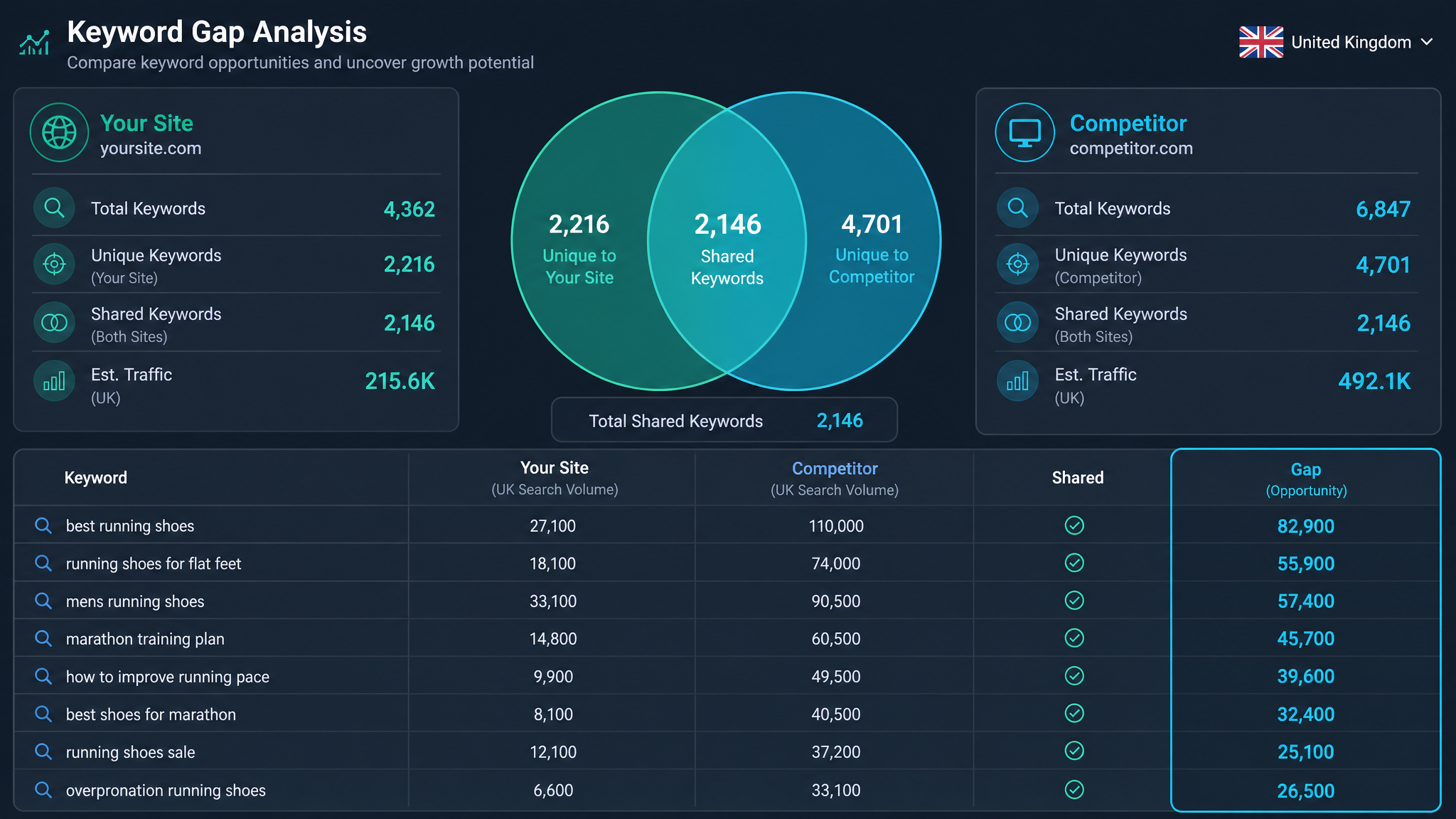
Free ebook: The Free SEO Stack
Keyword research without paying for Ahrefs — the complete guide. Read it online or download the PDF.
100% free · No spam · Unsubscribe any time
If you're fed up with chucking content into the SEO abyss and hoping for the best, it’s time to get forensic. Enter competitor keyword analysis—the digital equivalent of peeking at your rival’s exam paper (only this time, it’s not cheating, it’s strategy). This is your unfair advantage for 2026. Instead of wasting months on guesswork, you’ll get a crystal-clear map showing exactly which keywords are actually driving traffic for your competitors—and, more importantly, where the cracks in their armour are.
This guide isn’t another American import stuffed with New York pizza metaphors. It’s built for UK marketers, SEOs and business owners who want a playbook that works for the British market—regional quirks, spelling squabbles and all. Expect to learn what competitor keyword analysis actually is, how to spot your real competition (not just the one you moan about in meetings), a four-step process for extracting actionable SEO gold, UK-specific angles most guides skip, and how to turn all that juicy data into a content strategy that delivers real results.
Table of Contents
What Is Competitor Keyword Analysis and Why Does It Matter in 2026?
Let’s cut to the chase: competitor keyword analysis is about reverse-engineering the SEO battlefield. You dig into which search terms your rivals are crushing it with—both organic and paid—then use that intelligence to guide your own content and SEO moves. Forget brainstorming in a vacuum. Just follow the trail of what’s already working.
Why does this matter more than ever in 2026? Because AI-generated content has stuffed the SERPs like a cheap sausage roll—lots of filler, not much flavour. Sorting signal from noise is a nightmare. Competitor keyword analysis lets you sidestep that chaos. It points straight at what real competitors with real audiences are ranking for—think of it as using a satnav instead of wandering the woods with a sketchy map.
And if you’re in the UK? The rules change again. Local intent, regional word choices, and a different breed of competition mean that copy-pasting some US keyword strategy is about as effective as sending a Cornish pasty to a Texan barbecue. Skip competitor analysis at your peril: you’ll waste time on keywords that either lead nowhere or are impossible to rank for on this side of the Atlantic. Do it right, and you’ll spot golden content gaps your competition has left wide open for years.
Identifying Your True Competitors (Not Just the Obvious Ones)
Direct vs. Indirect Competitors in the UK Market
Here’s what most people miss: not all competition is head-to-head. Direct competitors flog the same stuff to the same people (think London accountants vs. other London accountants). But indirect competitors are the sneaky ones—targeting the same audience but with different solutions. That accountant? They’re also up against Xero, FreeAgent, and anyone offering DIY tax help online.
Many businesses get tunnel vision, obsessing over direct rivals. But often, indirect competitors are the ones quietly hoovering up the keywords you care about. For example, a solicitor focused on employment law might find a legal charity nabbing top spots for the queries they want—and analysing the charity’s approach can reveal topic gaps you haven’t even considered.
Want to spot who’s really in your SEO race? Fire up Google Search Console, see which domains keep popping up for your top queries, then do some manual SERP sleuthing for your five most prized keywords. Note everyone who regularly makes the top ten. You’ll uncover a few dark horses.
How to Build a Competitor Shortlist (5–10 Domains)
Don’t just grab the first five names that spring to mind. Start with your three to five highest-priority organic keywords. Who’s always in the top ten for those? Now peek at who’s shelling out on PPC for the same terms—if they’re paying, they’ve done their homework.
Aim for at least one ‘aspirational’ competitor (the big name to chase) and one up-and-comer (the scrappy, agile challenger). UK relevance is key: filter by .co.uk domains or localised results. Five to ten domains is the sweet spot. Fewer than five and you’ll miss blind spots; more than ten and you’ll drown in data.
The Step-by-Step Process for Competitor Keyword Analysis
Step 1 – Gather Your Competitors' Keywords Using Tools
Ready to roll up your sleeves? Start by exporting your rivals’ top organic and paid keywords from tools like SpyFu, Semrush, Ahrefs, or Mangools. The gold is in keywords where they rank positions one to ten—these are winnable and show Google already trusts sites like yours for those terms.
Sure, check keyword difficulty and search volume. But don’t get dazzled by big numbers. Sometimes a ‘tiny’ keyword like “emergency plumber Clapham” (50 searches a month) is worth more than a generic term with 5,000 monthly tyre-kickers. And here’s a facepalm-level warning: make sure your tool is set to the UK database, typically location code 2826, and UK English. Analysing US data is like bringing a cricket bat to a baseball game.
Step 2 – Segment Keywords by Intent and Opportunity
Now you’ve got your pile of keywords, time to sort them: informational (answering questions), commercial (researching before buying—e.g. “best accounting software for freelancers”), transactional (ready to buy—“hire accountant London”), and navigational (brand or site names).
For quick ROI, chase commercial and transactional terms—they drive the real business. Use informational ones to build trust (and backlinks). Within each group, snoop for low-hanging fruit: spots where a competitor is ranking with weak, thin, or ancient content. Structure helps: start with seed terms, cluster related keywords, then expand with your tool’s suggestions. Sarah Worboyes swears by this method—and she’s not wrong. It’s way better than the classic “throw spaghetti at the wall” approach.
Step 3 – Perform a Keyword Gap Analysis
Here’s where things get spicy. A keyword gap analysis is your detective’s magnifying glass, showing exactly which keywords your competitors rank for and you don’t. Tools like Semrush and Mangools have this built in; SpyFu’s Keyword Overlap does the job too.
Prioritise gaps where the rival’s domain authority is in that tasty 30–50 range and where the keyword is ‘money’ (commercial intent). These are your winnable battles: not so competitive you’ll burn out, but valuable enough to be worth the push. Document everything—keyword, search volume, difficulty, competitor URL, and your notes on why their content is beatable. This becomes your live battle plan.
Step 4 – Analyse Competitor Content to Understand Why They Rank
Numbers tell you what, but content tells you why. Visit the top-ranking pages for each juicy keyword. Scan the title tags, headings, word count, images, video, internal links and—yes—backlinks. Spot patterns in the top five: are listicles king? Are guides or tables running the show? What grabs the featured snippet?
Don’t just parrot what’s there. Your mission: figure out the standard, then beat it. Make your content more useful, more UK-specific, fresher, or simply more readable. That’s how you leapfrog the competition.
UK-Specific Considerations for Competitor Keyword Analysis
Local SEO and Regional Keyword Variations
Bet you didn’t realise how many British/American word swaps mess with your SEO. ‘Flat’ not ‘apartment’, ‘trainers’ not ‘sneakers’, ‘solicitor’ not ‘lawyer’... the list goes on. Make sure your analysis snags both variants, but double-down on what your audience actually types into Google.
For local businesses, location keywords are your bread and butter. A Bristol estate agent needs to cover not just ‘estate agent’ but everything from ‘estate agent Clifton’ to ‘estate agent BS1’. Google Business Profile can show you the local queries your competitors are killing it for—cross-check this with your main keyword tools. And here’s a secret: most guides barely mention local SEO. Dive deep, and you’ll grab easy wins others miss.
B2B vs. B2C Keyword Strategies
B2B is a different beast. Focus on long-tail, pain-point keywords (think "inventory management challenges for UK manufacturers"). These convert like a dream compared to high-volume, generic stuff.
B2C? Go broader and watch for seasonal spikes—Google Trends (set to UK) is your mate here. In B2B, map keywords to each buyer journey stage and see which competitors own which phase. Most guides lump B2B and B2C together, but splitting them is how you get proper, actionable insights.
Tools for Competitor Keyword Analysis in 2026
Paid Tools Worth the Investment
Some paid tools are worth their weight in gold (or at least, in saved hair-pulling). SpyFu boasts 7.2 trillion results, 13.1 billion keywords, 152 million sites and data updated every 15 seconds. Its ace card? SpyFu GPT—an AI layer that lets ChatGPT answer your big strategic questions, based on live competitor data. UK users get deep historical data too—great for spotting trends going back years.
Semrush is your keyword gap and organic research workhorse, with a chunky UK database. Ahrefs shines for backlink analysis and has solid keyword difficulty scoring for UK terms. Mangools is the budget pick—simple, affordable, and covers 158 million keywords in 22 countries. SE Ranking’s a good all-rounder if you’re after something approachable and cost-effective. If you want to compare the lot, check our full guide to the best SEO keyword tools in the UK for 2026.
Free Tools to Supplement Your Analysis
You don’t have to remortgage the house to get started. Google Search Console shows which queries are already bringing you traffic and—by inference—where competitors are winning head-to-head. Google Keyword Planner is handy, but better for PPC than organic.
Ubersuggest gives you a free peek at competitor keywords, handy for early-stage research. And never underestimate the power of old-fashioned manual SERP analysis: slap your chosen keywords into Google (incognito, naturally) and see who’s showing up, what formats dominate, and which domains are everywhere. Sometimes, low-tech beats high-tech for local or SERP feature nuances.
Turning Competitor Keyword Data into an Actionable Content Strategy
Raw keyword spreadsheets are like gym memberships: useless unless you actually use them. Take your prioritised keywords and map them to pages you’ve already got (that could do with a tune-up) and to new pages that fill glaring content gaps. Build a calendar that mixes quick wins (easy keywords, old pages) with big-ticket projects (new pillar pages for competitive terms).
Before you write a word, decide on content type, word count, and how you’ll weave in internal links. Set real timelines: three to six months to rank for easy pickings, six to twelve months for tougher targets. Use rank trackers to measure progress and adjust on the fly. If a competitor gets wind and bulks up their own content? Rinse and repeat—that’s how modern SEO stays on top.
Common Mistakes to Avoid in Competitor Keyword Analysis
Let’s save you some facepalm moments:
Final Checklist for Your Competitor Keyword Analysis
Remember: competitor keyword analysis isn’t about plagiarism. It’s about finding the gaps your rivals missed and filling them with content that actually serves your UK audience. Start with a focused list, pick tools that suit your budget, and always favour intent over raw search volume. The winners in search aren’t the ones spending the most—they’re the ones who know exactly where to aim.
Free tools to put this into practice
Reading is one thing — testing your own pages is what moves the needle. Here are the free KeywordNumbers tools that pair best with this guide:
Every one of our free SEO tools is genuinely free to use, with no sign-up required.
Try the Keyword Gap Analysis Tool
Good news — there's now a free tool for exactly this. Give our Keyword Gap Analysis Tool a go and put this guide straight into practice.
Free ebook: The Free SEO Stack
Keyword research without paying for Ahrefs — the complete guide. Read it online or download the PDF.
- Which free tools replace Ahrefs, SEMrush & Moz
- Step-by-step keyword research workflow
- How to find content gaps without paying a penny
- The exact stack KeywordNumbers is built on
100% free · No spam · Unsubscribe any time
Ready to research your keywords?
Try our free keyword tools — no signup required.