Keyword Clustering Tool: The SEO Shortcut That Sorts Your Chaos into Clicks
Print / Save as PDFInsider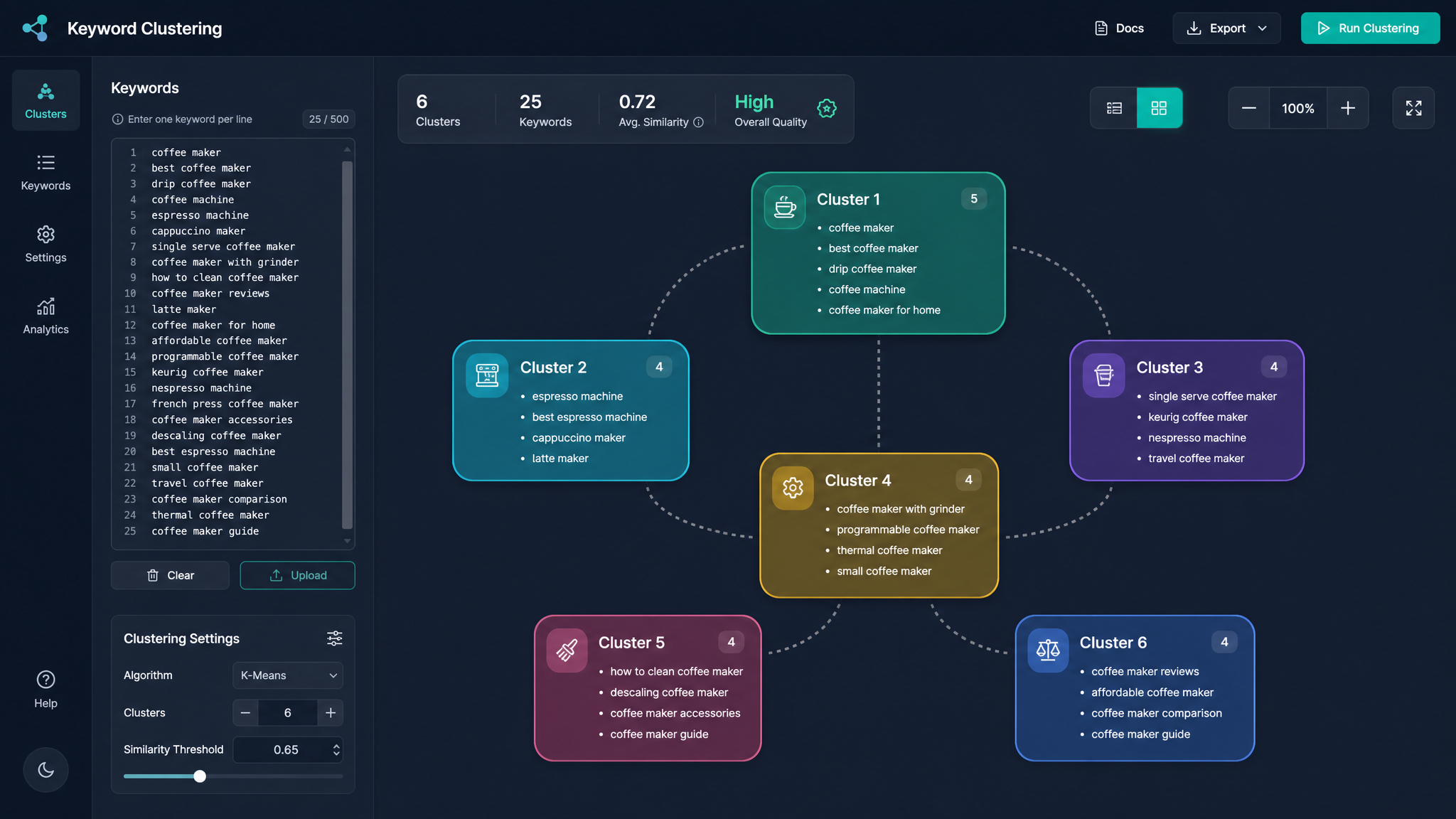
Free ebook: The Free SEO Stack
Keyword research without paying for Ahrefs — the complete guide. Read it online or download the PDF.
100% free · No spam · Unsubscribe any time
Ever stared at a 2,000-keyword spreadsheet and felt your soul leave your body? Yeah, most of us have. But there’s a way to turn that digital haystack into tightly grouped needles—each primed to rank. Enter the keyword clustering tool. In this guide, you’ll learn what keyword clustering is, why it beats old-school keyword lists, how to use a tool to do the grunt work, and see a real example (with numbers!) that’ll make it all click. Ready to wrangle your keywords?
Why Keyword Clustering Matters (and Why You Should Care)
Here’s what most people miss: Google doesn’t just match search terms to pages like a bored librarian. It tries to serve up the best answer—even if the query’s phrased differently. If you’re writing a separate page for every minor keyword variation, you’re not building a library. You’re building a labyrinth.
Keyword clustering lets you group related queries together, so you can target a whole topic with one strong page—not 27 nearly identical ones. It’s like organising your kitchen: keep all the baking gear in one drawer so you aren’t hunting for that one spatula when the timer’s going off.
What Is Keyword Clustering?
Let’s keep it simple: Keyword clustering is the process of grouping similar or closely related keywords based on their intent or topical similarity. Instead of treating “best running shoes”, “top trainers for running”, and “running shoes for men” as completely separate, you cluster them. This way, one killer page can rank for all three (and their friends).
The old approach? Make a page for every keyword and hope Google isn’t paying attention. The modern approach: clusters.
How Does a Keyword Clustering Tool Work?
Manually sifting through thousands of keywords is like sorting your sock drawer after a tornado. A keyword clustering tool does the heavy lifting for you:
It’s a bit like using a metal detector, but instead of bottle caps, you’re unearthing golden content opportunities.
Worked Example: Clustering in Action
Let’s say you’ve got these keywords:
| Keyword | Search Volume (UK/month) | Difficulty |
|---|---|---|
| best running shoes | 5,000 | 28 |
| top running shoes | 1,200 | 25 |
| running trainers | 1,500 | 24 |
| running shoes for men | 2,000 | 27 |
| best running trainers 2024 | 700 | 30 |
| marathon running shoes | 1,100 | 31 |
| best marathon trainers | 300 | 32 |
| running shoes for wide feet | 900 | 26 |
Run these through a keyword clustering tool, and here’s what you might get:
| Cluster Key | Clustered Keywords |
|---|---|
| best running shoes | best running shoes, top running shoes, best running trainers 2024, running trainers, running shoes for men |
| marathon running shoes | marathon running shoes, best marathon trainers |
| running shoes for wide feet | running shoes for wide feet |
Notice how five keywords fall neatly into a single cluster. Instead of writing five pages, you create one comprehensive guide. That’s less work, more rankings—and far less chance of Google’s algorithm giving you the cold shoulder for duplicate content.
How to Use a Keyword Clustering Tool (Without Losing Your Mind)
Bet you didn’t realise: you don’t need a PhD in data science. Here’s the quick-and-dirty process:
When Should You Cluster (And When Can You Skip It)?
Not every project needs a 100-keyword, multi-cluster extravaganza. Here’s when clustering is worth the effort:
If you’re only targeting a handful of keywords, clustering is like bringing a bulldozer to plant petunias. But for big lists, it’s the only sane way forward.
Questions People Are Actually Asking
What is a keyword cluster?
A keyword cluster is a group of closely related search terms that share the same intent or topic. Instead of treating each keyword as a separate silo, you group similar ones together and target them on a single, comprehensive page.
What is a cluster key?
A cluster key is the main or most representative keyword in a cluster. Think of it as the headline act at a music festival: it draws the crowd, while the supporting keywords add depth and relevance to your content.
What is keyword clustering?
Keyword clustering is the process of organising keywords into groups based on their semantic similarity or shared search intent. This helps you plan content that ranks for multiple related terms instead of spreading your efforts too thin.
What is a cluster tool?
A cluster tool—like the KeywordNumbers keyword clustering tool—is software that automatically sorts your keyword list into logical groups, saving you hours (and your sanity).
How do you put keywords into clusters?
You can cluster keywords manually by scanning for overlaps and similarities, but with hundreds of keywords, it’s faster (and less soul-destroying) to use a dedicated clustering tool that analyses SERPs and groups keywords for you.
What is a cluster in software?
In software, a "cluster" usually means a group of computers or servers working together. In SEO, though, a cluster refers to a group of related keywords—not machines—so don’t get them mixed up at your next team meeting.
Final Thoughts: One Tool, Many Rankings
If your keyword spreadsheet is starting to look like a Jackson Pollock painting, it’s time to bring in a keyword clustering tool. You’ll cut down on duplicate content, plan smarter, and make Google’s job easier (which is always a win).
Ready to tame your keyword chaos? Try the KeywordNumbers keyword clustering tool now and see how tidy your SEO strategy can get.
Free tools to put this into practice
Reading is one thing — testing your own pages is what moves the needle. Here are the free KeywordNumbers tools that pair best with this guide:
Every one of our free SEO tools is genuinely free to use, with no sign-up required.
Free ebook: The Free SEO Stack
Keyword research without paying for Ahrefs — the complete guide. Read it online or download the PDF.
- Which free tools replace Ahrefs, SEMrush & Moz
- Step-by-step keyword research workflow
- How to find content gaps without paying a penny
- The exact stack KeywordNumbers is built on
100% free · No spam · Unsubscribe any time
Ready to research your keywords?
Try our free keyword tools — no signup required.