KeywordNumbers
Back to Blog
SEO

Keyword Difficulty Explained: How to Use It for Better SEO Rankings

Graham KeywordnumbersMay 28, 20269 min read
Keyword Difficulty Explained: How to Use It for Better SEO Rankings

Keyword difficulty is one of those SEO terms that sounds complicated but is actually simple once you understand it.

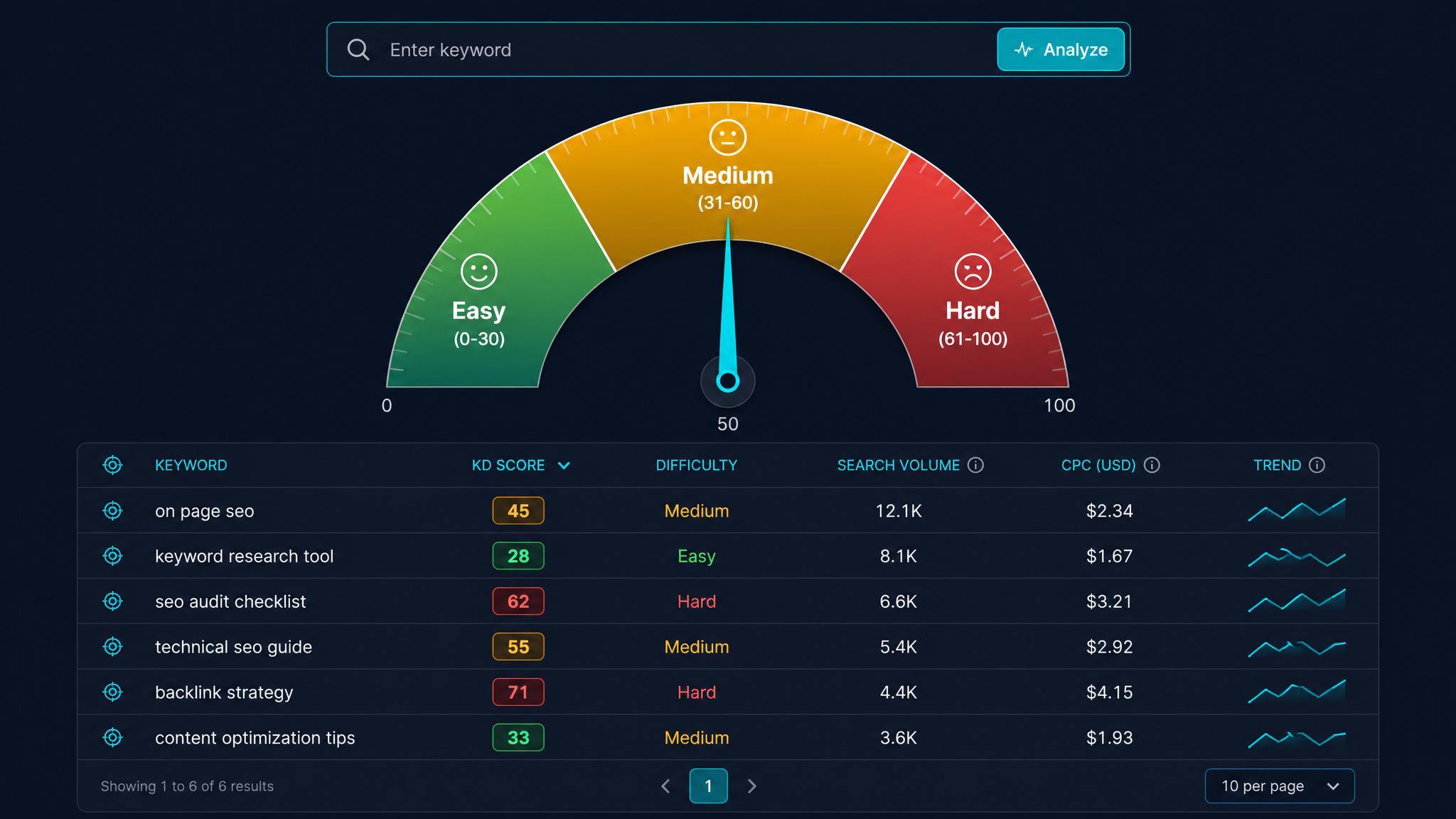
  • Here's the plain-English version:* Keyword difficulty is a score (usually 0–100) that tells you how hard it would be for your website to rank for a specific keyword.
  • A difficulty of 10 means "relatively easy to rank for" (compared to other keywords). A difficulty of 90 means "you'd probably need a massive, well-established site to rank for this." Most tools color-code them: green for easy, yellow for medium, red for hard.

    Why does this matter? Because it saves you from wasting time writing amazing content for keywords you can't rank for. A brand-new website ranking for "best CRM software" (probably difficulty 80+) is almost impossible. But that same new site ranking for "best CRM software for freelancers on a budget" (probably difficulty 30–40) is totally doable.

    Keyword difficulty tells you the playing field. It helps you pick battles you can actually win.

    How is Keyword Difficulty Calculated?

    SEO tools don't have access to Google's internal algorithms, so they make educated guesses. But they're pretty good guesses.

    Most tools calculate keyword difficulty by analyzing:

  • 1. Domain authority of top-ranking sites - If the top 10 results are all from authority domains (Forbes, Wikipedia, major brands), the difficulty is high. If they're from smaller blogs and mid-tier websites, it's lower.
  • 2. Number and quality of backlinks - The top-ranking pages are analyzed for the number of backlinks pointing to them. More backlinks = higher difficulty to beat them.
  • 3. Content quality and depth - Tools scan the top results to see how comprehensive they are. Simple, thin content = lower difficulty. In-depth, well-researched content = higher difficulty.
  • 4. SERP composition - Are there paid results above the organic results? (Higher difficulty.) Is it a "featured snippet" heavy query? (Different difficulty calculation.) These factors matter.
  • 5. Search volume - Higher volume keywords tend to have higher competition and thus higher difficulty.
  • Domain-level SEO signals - How old are the top-ranking domains? How many pages do they have? How much traffic do they get? These all factor in.
  • The result is a score. KeywordNumbers and most other tools score it 0–100 for easy comparison. Every tool's algorithm is slightly different, but they're usually in the same ballpark.

  • Important: Keyword difficulty is a guide*, not gospel. It's possible for a smaller site to rank for a "hard" keyword if the content is exceptional. Conversely, you might struggle with a "medium" difficulty keyword if the competition is fiercer than expected. Always verify with manual SERP analysis.
  • Understanding the Keyword Difficulty Score (0–100)

    Here's how to interpret the numbers:

    0–20: Very Easy

    These keywords are genuinely low-competition. New sites, small blogs, and startups can rank for these with decent content and basic SEO.

  • What to expect:* Quick ranking (4–12 weeks), less competitive backlink environment, easier SERP to beat.
  • Example keyword:* "How to use Notion templates for freelancers" - probably difficulty 15–20, good for a niche blog or freelancer portfolio.
  • Who should target these:* Newer sites, personal blogs, small businesses just starting with SEO.
  • 21–40: Easy

    Still very doable, especially if you have a site that's a few months old or if you're building authority in a niche.

  • What to expect:* Ranking in 8–16 weeks with solid content, some backlink requirements, moderate competition in SERP.
  • Example keyword:* "Best project management tools for nonprofits" - probably difficulty 30–35, very beatable if you create comprehensive content.
  • Who should target these:* Newer sites with some content under their belt, established sites in competitive niches, content marketers building backlinks.
  • 41–60: Medium

    Now you're in "medium" difficulty territory. These keywords require solid content and some SEO work (backlinks, domain authority).

  • What to expect:* Ranking in 12–24 weeks, need multiple backlinks, top-ranking sites are well-written, your content needs to be notably better.
  • Example keyword:* "Content marketing strategy for B2B SaaS" - probably difficulty 45–50, beatable if you have decent domain authority and create exceptional content.
  • Who should target these:* Established sites with some authority, sites with 6+ months of consistent content, sites willing to invest in backlinks.
  • 61–80: Hard

    These are competitive. You'll need strong domain authority, exceptional content, and a solid backlink strategy. This is where big brands and established publishers live.

  • What to expect:* Ranking in 6+ months or longer, significant backlink investment, top-ranking sites are from established brands or high-authority publications.
  • Example keyword:* "Best email marketing software" - probably difficulty 75+, reserved for established brands and major publications unless you have exceptional domain authority.
  • Who should target these:* Established sites with authority in the space, brands/publications with existing audience, competitive markets where you have a unique angle.
  • 81–100: Very Hard

    These are typically dominated by major brands, Fortune 500 companies, or massive publishers. Ranking here as a new or small site is possible but extremely unlikely.

  • What to expect: Very difficult to rank (even with effort), reserved for authority domains, would require exceptional content and* major backlink strategy.
  • Example keyword:* "Best CRM software" - probably difficulty 85+, dominated by major publications and software review sites.
  • Who should target these:* Only if you're a major brand in the space or have significant existing authority.
  • Keyword Difficulty vs. Search Volume: Finding the Sweet Spot

    Here's where a lot of people get confused: a "hard" keyword with high search volume and an "easy" keyword with low search volume look different on paper, but what matters is the combination.

    Example 1:

  • Keyword: "Email marketing software"
  • Difficulty: 85
  • Search volume: 50,000/month
  • Result:* Massive opportunity IF you have domain authority and backlinks. But for a new site? Probably not worth the effort.
  • Example 2:

  • Keyword: "How to build email list with lead magnets"
  • Difficulty: 35
  • Search volume: 800/month
  • Result:* Much better target. Lower difficulty, real search volume, and more achievable for a smaller site.
  • The sweet spot:* Difficulty 20–50 with search volume 300–3,000/month. This is where new and medium-sized sites can win.
  • Use this chart to prioritize:

    Difficulty500+ searches/month100–500 searches/monthUnder 100 searches/month
    0–30🎯 IDEALGOODMarginal
    31–50GOOD🎯 IDEALMarginal
    51–70Worth tryingGOODSkip
    71+Only if you have authorityWorth trying if nicheSkip

    What Difficulty Level Should You Target Based on Domain Age?

    Not every site should target the same difficulty level. Your site's age and authority matter.

    Brand New Site (0–3 months)

    Target difficulty: 0–20

  • Your domain is too new to rank for anything competitive
  • Focus on building content and authority first
  • These easy keywords establish your credibility and get early traffic
  • Developing Site (3–12 months)

    Target difficulty: 20–40

  • You've got some content and authority now
  • Aim for low-to-medium difficulty keywords
  • Start building backlinks to support slightly competitive keywords
  • Established Site (1–3 years)

    Target difficulty: 30–60

  • You have domain authority now
  • You can tackle medium-difficulty keywords in your niche
  • Strong backlink profile helps you compete
  • Authoritative Site (3+ years)

    Target difficulty: 40–80

  • You're known in your space
  • You can compete for higher-difficulty keywords
  • Your existing traffic and backlinks give you an advantage
  • Important:* This is a guide, not a rule. A site with exceptional content and a smart backlink strategy can outrank sites older than them. But generally, newer sites should start with easier keywords.
  • Common Mistakes People Make with Keyword Difficulty
  • Mistake 1: Ignoring Difficulty Entirely

  • The problem:* You write a great article for a keyword with difficulty 85, and it never ranks because you can't compete with the authority sites already owning the SERP.
  • The fix: Always check difficulty before* writing. If it's above your site's capacity, pick a different keyword.
  • Mistake 2: Trusting Difficulty Without Checking the SERP

  • The problem:* A tool says difficulty is 30, but when you manually check, the top 10 are all major brands or authority sites. The tool was wrong.
  • The fix:* Always manually review the top 10 results. A 30-second SERP check beats relying on the tool alone.
  • Mistake 3: Targeting Only Zero-Difficulty Keywords

  • The problem:* You only target keywords with difficulty under 20, but they all have 50 searches/month. You're not getting meaningful traffic.
  • The fix:* Balance low difficulty with real search volume. Some keywords with difficulty 40–50 are better targets than low-difficulty, low-volume keywords.
  • Mistake 4: Assuming Low Difficulty = Easy to Monetize

  • The problem:* You rank for a low-difficulty keyword, but the searcher has no intent to buy or convert. It's free traffic that brings no business value.
  • The fix:* Match difficulty to search intent. A high-difficulty keyword with strong commercial intent might be better than an easy keyword with informational intent.
  • Mistake 5: Not Accounting for Your Site's Authority

  • The problem:* You're a 2-month-old site targeting difficulty 50–60 keywords. You don't rank, and you get frustrated.
  • The fix:* Match your difficulty targets to your site's age and authority. Start easier, work your way up.
  • How to Use Keyword Difficulty to Plan Your Content Strategy

    Difficulty score should directly inform your content calendar.

    Here's the strategy:

  • 1. Research keywords in your niche - Build a list of 20–50 keywords across your niche with their difficulty scores.
  • 2. Sort by difficulty - Separate them into easy (0–30), medium (30–50), and hard (50+).
  • 3. Create a phased plan:
  • Phase 1 (Months 1–2): Target only easy keywords (0–30). Build authority and early traffic.
  • Phase 2 (Months 3–5): Layer in medium keywords (30–50). You have more authority now.
  • Phase 3 (Months 6+): Go after harder keywords (50+). You can compete now.
  • 4. Interlink strategically - Your easy-keyword articles link to medium-difficulty articles, which link to your most competitive pieces. This amplifies your ranking power.
  • 5. Build backlinks to high-difficulty targets - Reserve your backlink strategy for your most important, higher-difficulty keywords where you want to dominate.
  • By phasing your strategy by difficulty, you build momentum. Early wins build authority. Authority lets you tackle harder keywords. Hard keyword rankings bring major traffic and revenue.

    Ready to research your keywords?

    Try our free keyword tools — no signup required.