Keyword Counter Tools: The Underrated Habit That Stops Google Playing Hide and Seek with Your SEO
Print / Save as PDFInsider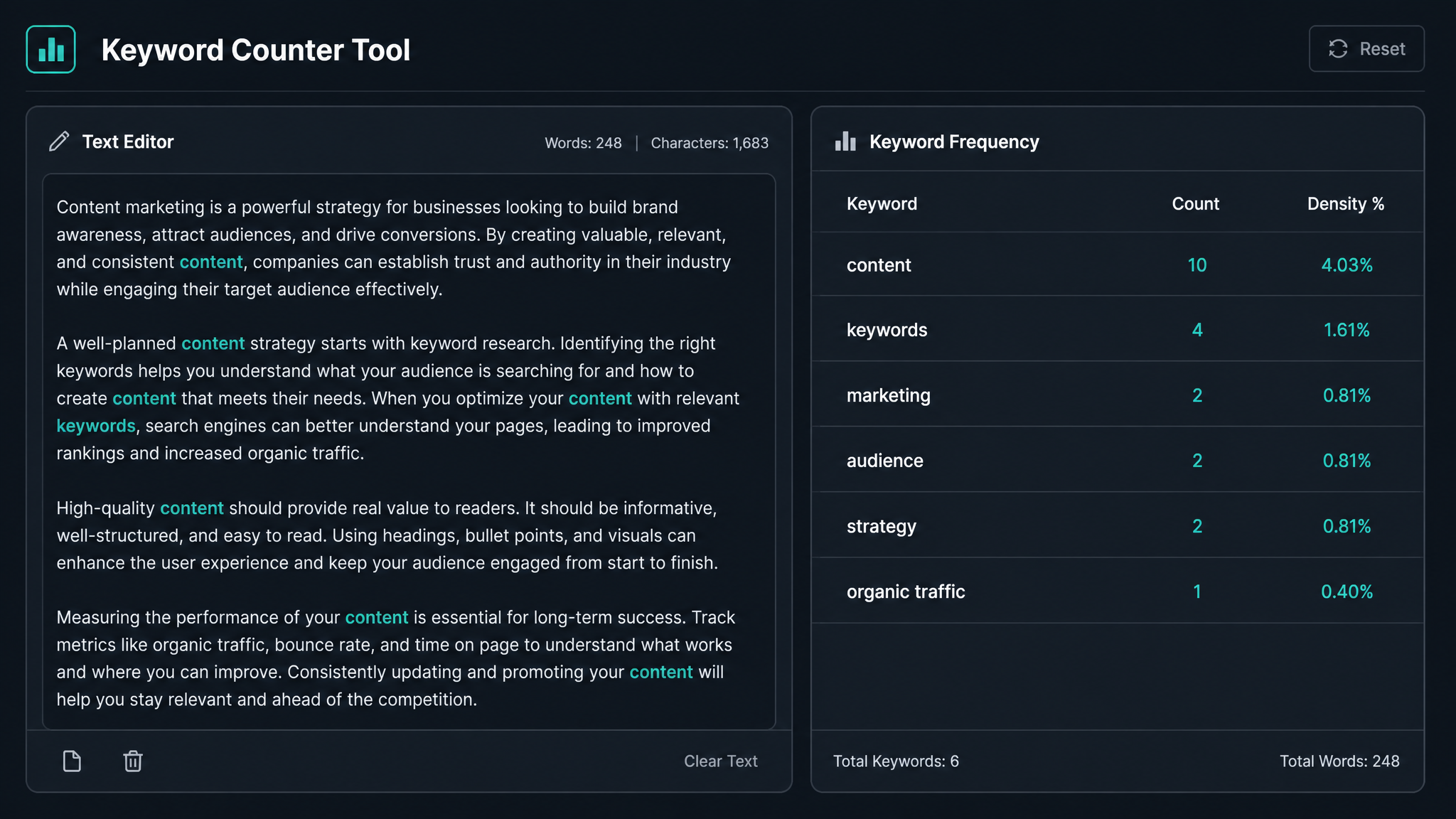
Free ebook: The Free SEO Stack
Keyword research without paying for Ahrefs — the complete guide. Read it online or download the PDF.
100% free · No spam · Unsubscribe any time
Let’s face it: SEO can feel like you’re trying to win a bake-off judged by robots. But if there’s one ingredient you can actually control, it’s your keyword count. Not just splattering your target phrase everywhere like ketchup at a kid’s party, but knowing exactly how often it crops up. That’s where a keyword counter tool comes in — the digital measuring jug for your content recipe.
This guide unpacks what a keyword counter tool actually does, why it matters for on-page SEO, and how to make it work for you. Expect practical steps, real numbers, and enough dry humour to keep even the weariest copywriter awake.
So, What’s a Keyword Counter Tool When It’s at Home?
Imagine you’re making soup. You wouldn’t just guess the salt, would you? (Your guests hope not.) A keyword counter tool is your salt shaker: it lets you check exactly how much of your target word or phrase you’ve sprinkled in. Rather than just giving you a plain old word count, these tools laser-focus on the specific terms you’re keen to rank for.
Why is this even a thing? Simple: Google wants you to be relevant, but not a try-hard. Too few mentions and you’ll never get a look-in. Too many, and you’re that overeager guest who brings up their new Peloton for the fifth time at dinner. Keyword stuffing is real, and Google’s not shy about penalising it. A keyword counter helps you land in the Goldilocks zone — not too much, not too little, just right.
If you want to play along, the Keyword Counter Tool on KeywordNumbers.com is free and takes about as long to use as making a cuppa.
Why Does Counting Keywords Actually Matter for On-Page SEO?
Your Step-By-Step Guide: Using a Keyword Counter Tool Like a Grown-Up
1. Nail Down Your Target Keywords
Ever tried archery blindfolded? Don’t do SEO like that. Start by researching your main and secondary keywords. Tools like Google Keyword Planner, SEMrush, or Ahrefs are your satnav here. Get your list ready — you’ll thank yourself later.
2. Draft or Paste Your Content
Bash out your draft, or paste what you’ve already got, into the keyword counter tool’s text box. Blog post, landing page, product description — if it’s got words, it’s fair game.
3. Enter Your Target Keywords
Type in your chosen keywords — one, ten, whatever floats your content boat. Many tools let you check a handful at once, which is a massive timesaver if you’re auditing a whole site.
4. Calmly Analyse the Results
The tool spits out how many times each keyword appears. Some even do you the favour of calculating keyword density (keyword count divided by total word count, then times 100). Think of it like a car dashboard — you’ll instantly see if you’re cruising or about to run out of petrol.
5. Adjust for Taste
If your keyword’s hiding, add it where it fits naturally. If it’s everywhere, swap some mentions for synonyms or reword clunky sentences. No need to sound like an ‘SEO bot 3000’ — clarity beats repetition every time.
Worked Example: The Nitty-Gritty of Keyword Counting
Let’s say you’re optimising a piece about ‘running shoes’. Here’s your sample:
> Finding the right running shoes is crucial for comfort and injury prevention. Whether you run 5 kilometres or 3 miles daily, your shoes need to support your feet and match your running style. The best running shoes offer cushioning, stability, and durability.
You’ve got ‘running shoes’ as your target keyword. How’s it stacking up?
| Keyword | Count |
|---|---|
| running shoes | 3 |
| shoes | 4 |
That’s a bit punchy — the recommended range for density is usually 1–3%, but context is king. If you’re writing for both UK and US folks, tossing in both ‘kilometres’ and ‘miles’ is a smart move too.
Tips for Getting the Most Out of Your Keyword Counter Tool
Manual Counting vs. Automated Tools: The Great Showdown
| Method | What’s Good | Where It Falls Down |
|---|---|---|
| Manual | No fancy tech; fine for super-short bits | Feels like counting grains of rice; easy to mess up |
| Automated Tool | Quick, accurate, checks loads at once | Can miss context (e.g., ‘run’ vs ‘running’) |
For anything longer than a tweet or more than one keyword, automated tools like the Keyword Counter Tool are the clear winner. Your sanity will thank you.
Questions People Are Actually Asking
What are the keys for word count?
Want the cheat sheet? You need accuracy (no guesswork), context (not every mention is equal), and clarity. In SEO, that means tracking both your total word count and how often your target keywords pop up. This helps you hit the sweet spot for both length and keyword use.
How do I use a keyword counter tool?
Easy: slap your content into the tool, type in your keyword(s), and hit go. The tool counts up the mentions — no mental arithmetic required. Adjust your content as needed, and watch your SEO shape up.
What is a good keyword density for SEO?
There’s no magic number, but 1–3% is usually thrown around by the pros. More important? Your content actually helps someone. Write like you’re explaining to a mate, not like you’re filling out a form. Too much repetition = spammy vibes.
Can a keyword count tool help avoid keyword stuffing?
Absolutely. It’s your early warning system. If you’re hammering the same word over and over, the tool lets you spot it before Google does. Trim or rewrite as needed, and you’ll dodge the penalty hammer.
Do keyword counter tools count variations and synonyms?
Most basic tools only count exact matches. Some fancier ones will spot variations or related words, but for most day-to-day SEO, counting exact matches is your bread and butter. For a full audit, look at synonyms too.
Is it important to count both single words and phrases?
Definitely. Google looks at both. Tracking just ‘SEO’ is half the story — ‘keyword research tool’ or other phrases matter too. It’s like checking the ingredients and the recipe title.
Can I use a keyword counter tool for competitor analysis?
You bet. Paste your competitor’s page into the tool and see which words they’re leaning on. It’s like peeking at their shopping list before you hit the shops yourself.
Conclusion
A keyword counter tool is the unsung hero in your SEO toolkit — quick, easy, and surprisingly powerful. Keep track of your keyword usage and you’ll serve up content Google loves (without boring your readers to death). The Keyword Counter Tool on KeywordNumbers.com is free, fast, and refreshingly signup-free. Give it a bash and see what you’ve been missing.
Free tools to put this into practice
Reading is one thing — testing your own pages is what moves the needle. Here are the free KeywordNumbers tools that pair best with this guide:
Every one of our free SEO tools is genuinely free to use, with no sign-up required.
Try the Word Counter
Good news — there's now a free tool for exactly this. Give our Word Counter a go and put this guide straight into practice.
Free ebook: The Free SEO Stack
Keyword research without paying for Ahrefs — the complete guide. Read it online or download the PDF.
- Which free tools replace Ahrefs, SEMrush & Moz
- Step-by-step keyword research workflow
- How to find content gaps without paying a penny
- The exact stack KeywordNumbers is built on
100% free · No spam · Unsubscribe any time
Ready to research your keywords?
Try our free keyword tools — no signup required.