Keyword Gap Analysis Tool: The Secret Weapon Your Competitors Hope You Never Find
Print / Save as PDFInsider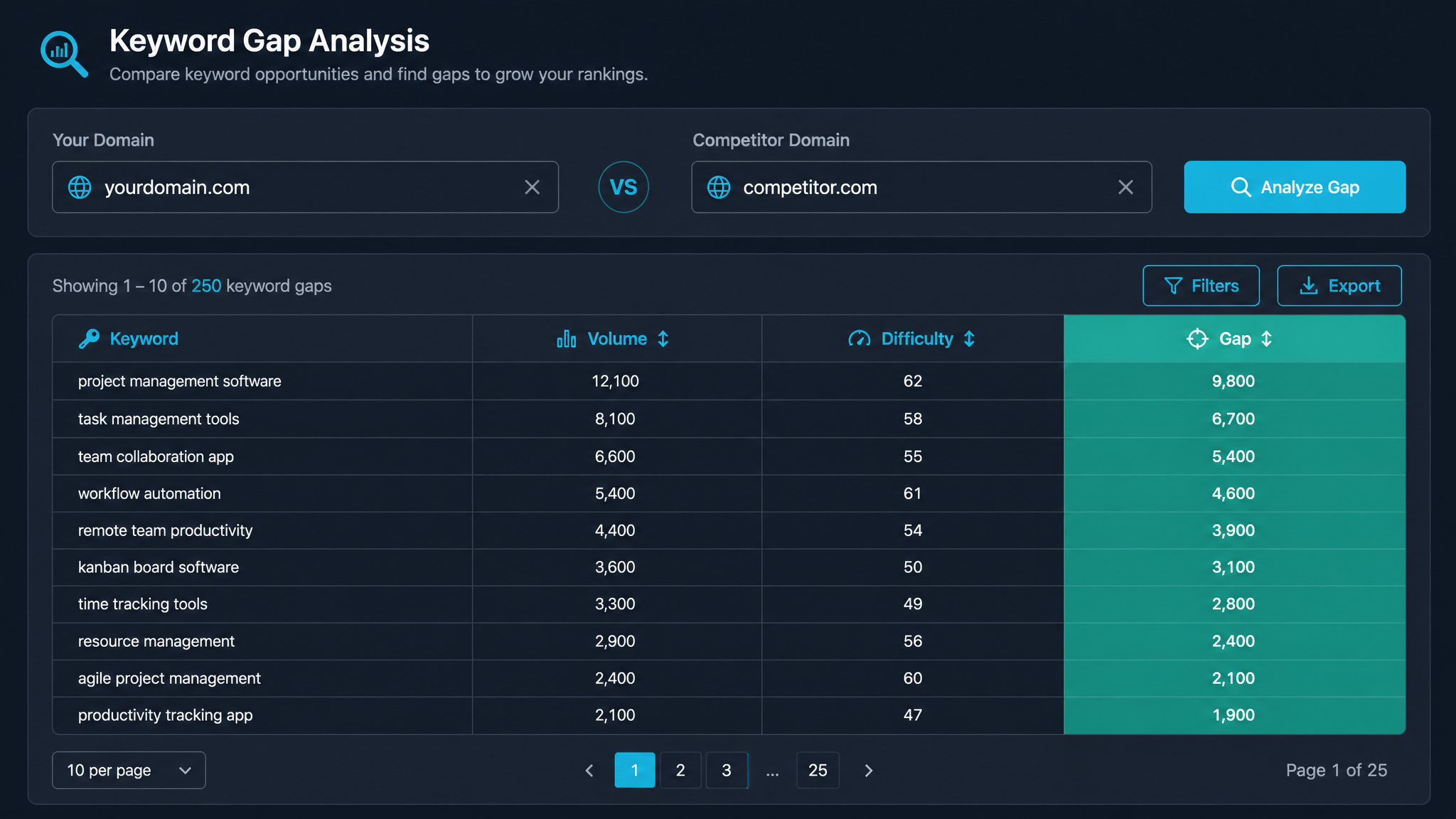
Free ebook: The Free SEO Stack
Keyword research without paying for Ahrefs — the complete guide. Read it online or download the PDF.
100% free · No spam · Unsubscribe any time
Ever feel like you’re running an SEO race with your shoelaces tied together? That’s what skipping keyword gap analysis is like. Today, you’ll learn how to use a keyword gap analysis tool to spot the precise keywords your competitors rank for (but you don’t), why it matters, and how to actually do something about it. Spoiler: this is the fastest way to find easy-win keywords and leapfrog your rivals in Google’s results.
What Is a Keyword Gap Analysis (and Why Should You Care)?
Here’s what most people miss: keyword gap analysis is like peeking at your neighbour’s exam answers, but totally legal and 100% encouraged. It’s the process of comparing your keyword rankings with your competitors’ to highlight the juicy search terms you’re missing out on. Think of it as your SEO shopping list — except instead of groceries, you’re grabbing traffic opportunities.
A keyword gap analysis tool automates this: plug in your site and the competition, and it spits out a list of keyword gaps faster than you can say "Why didn’t I do this sooner?"
How Does a Keyword Gap Analysis Tool Work?
Picture a Venn diagram. One circle is your keywords, the other is your competitor’s. The overlap? That’s where you’re both fighting for attention. The bits that only show up for your competitor? Those are your missed chances — your keyword gaps.
A tool like this free keyword gap analysis tool crunches the numbers by:
If you’ve ever used a calorie counter to see where those sneaky snacks are hiding, you get the idea — it’s about finding what’s missing so you can fix it.
Step-by-Step: How to Use a Keyword Gap Analysis Tool
Bet you didn’t realise how simple this can be. Here’s how to run a keyword gap analysis without needing a PhD in data science:
Worked Example: Closing the Gap (With Actual Numbers)
Let’s say you run a site selling eco-friendly trainers. You and your top competitor, GreenSole, both target “eco trainers UK”. But GreenSole also ranks for:
| Keyword | Monthly Searches | You Rank | GreenSole Rank |
|---|---|---|---|
| vegan running shoes | 1,800 | — | 5 |
| sustainable trainers | 1,300 | — | 8 |
| recycled material shoes | 950 | — | 12 |
| eco trainers UK | 2,100 | 7 | 3 |
That’s over 4,000 extra searches a month (about 4,400 if you’re counting) that you’re missing — and yes, that’s about 1,000 gallons (or roughly 3,785 litres) of traffic in SEO terms. Your job: create or optimise pages for “vegan running shoes”, “sustainable trainers”, and “recycled material shoes”.
Common Mistakes (And How to Dodge Them)
How to Document and Action Your Keyword Gap Analysis
A keyword gap analysis is only as good as what you do with it. Here’s a simple workflow:
Pro tip: Keep your findings in a shared spreadsheet. It’s your SEO treasure map — and much harder to lose than a Post-it note stuck to your monitor.
Questions People Are Actually Asking
How to use gap analysis?
Start by listing your keywords and your main competitors’. Use a keyword gap analysis tool to compare the lists, spot missing keywords, and prioritise which ones to target by search volume and relevance to your business. Then, update your content or create new pages to close those gaps.
What are keyword gaps?
Keyword gaps are search terms your competitors are ranking for but your site isn’t. These represent missed opportunities—think of them as free seats at the SEO table you haven’t claimed yet.
How to read a gap analysis?
Focus on the list of keywords your competitors rank for, but you don’t. Check the monthly search volume and ranking difficulty to decide which gaps are worth chasing. The most valuable gaps are those with healthy search volume and a realistic chance of ranking.
How to document a gap analysis?
Record your findings in a spreadsheet or project management tool. Include columns for the keyword, current rankings (yours and competitors’), search volume, difficulty, and next steps (e.g., optimise page X, create new article on Y). Update it regularly to track your progress.
How to make a gap analysis?
Choose your competitors, gather their keyword data (using a gap analysis tool), compare with your own keyword rankings, and list the keywords you’re missing. Then, prioritise and act on them based on potential value and ease of winning.
How to do a gap analysis?
Select 2-4 competitors, run both your site and theirs through a keyword gap analysis tool, and review the results. Focus on high-potential keywords where you’re absent, then add them to your content strategy.
Conclusion: Ready to Find Your Easy SEO Wins?
Keyword gap analysis isn’t just another SEO chore — it’s the shortcut to leapfrogging your rivals. You’ll know exactly where to focus, what to write, and how to outmanoeuvre the competition. So go on, give the KeywordNumbers Keyword Gap Analysis Tool a spin today, and start closing those gaps. Your next traffic jump might be one keyword away.
Free tools to put this into practice
Reading is one thing — testing your own pages is what moves the needle. Here are the free KeywordNumbers tools that pair best with this guide:
Every one of our free SEO tools is genuinely free to use, with no sign-up required.
Free ebook: The Free SEO Stack
Keyword research without paying for Ahrefs — the complete guide. Read it online or download the PDF.
- Which free tools replace Ahrefs, SEMrush & Moz
- Step-by-step keyword research workflow
- How to find content gaps without paying a penny
- The exact stack KeywordNumbers is built on
100% free · No spam · Unsubscribe any time
Ready to research your keywords?
Try our free keyword tools — no signup required.