SEO Keyword Mapping Template: The Sat Nav Your Pages Didn’t Know They Needed
Print / Save as PDFInsider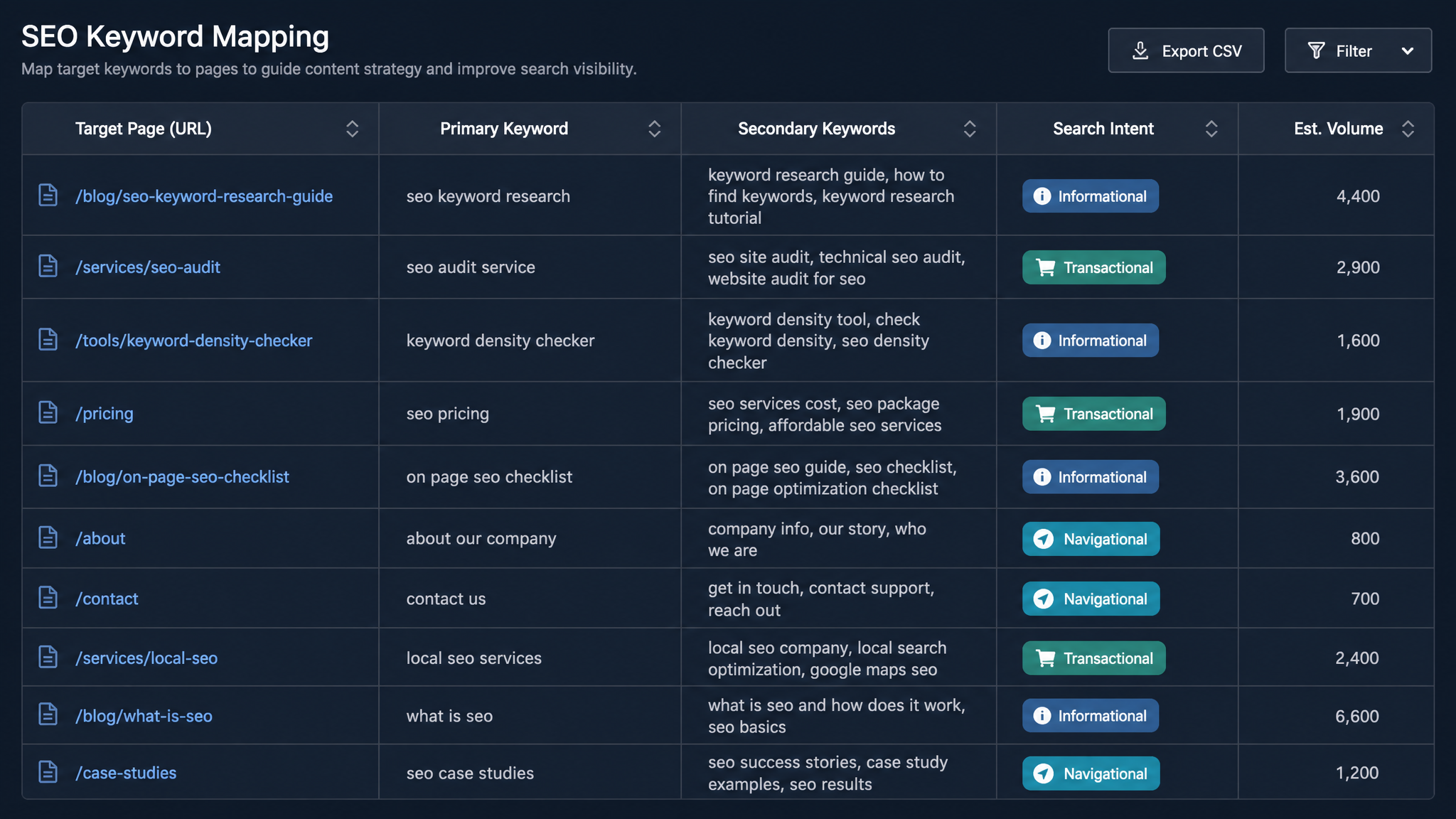
Free ebook: The Free SEO Stack
Keyword research without paying for Ahrefs — the complete guide. Read it online or download the PDF.
100% free · No spam · Unsubscribe any time
Let’s be honest: most people’s approach to keywords is like tossing spaghetti at the wall and hoping Google likes the pattern. But if you actually want your site to climb those search results, you need more than a chaotic noodle pile. You need a plan—a proper map connecting what your audience is searching for to the exact pages that deserve the clicks. In this guide, I’ll walk you through what a keyword mapping template actually is, how to use one for SEO that works, and yes, how to build your own with free tools (because who doesn’t love a freebie?).
What Is Keyword Mapping in SEO? (And Why Your Site Needs Sat Nav)
Think of keyword mapping like running a taxi firm. You don’t want five drivers fighting over the same fare, or worse, missing passengers altogether. Keyword mapping is the process where you assign each keyword (and its polite cousins—variations) to a specific page on your site. Every page gets its own little patch to garden, so you don’t end up with overgrown weeds (cannibalisation) or barren turf (missed opportunities).
A keyword mapping template is just your master spreadsheet for this. It helps you:
Why Bother With a Keyword Mapping Template? (Or, How to Dodge SEO Chaos)
Here’s what most people miss: without a keyword map, you’re basically flying blind. You might accidentally target the same keyword on three pages, Google gets confused, and you end up ranking for nothing. Or you could skip entire search intents your competitors are scooping up.
A proper template doesn’t just tidy up your keyword chaos. It makes the whole process repeatable, scalable, and a heck of a lot less overwhelming as your site balloons with content. Think of it as the Marie Kondo of on-page SEO.
How to Create a Keyword Mapping Template (The 5-Step Plan)
Ready to get your digital ducks in a row? Here’s how to build a keyword map that actually works:
1. Gather Your Keyword Research
Start with a keyword research tool and hoard a list of relevant terms like a doomsday prepper with tinned beans. For example, if your site is about home improvement and you want to rank for “garden decking”, you might find:
If you want to skip the manual sorting, the free Keyword Clustering Tool on KeywordNumbers will do the heavy lifting and group related search terms automatically.
2. Group Related Keywords (AKA Herding Cats)
Now, cluster those keywords by topic and intent. The goal? Turn keyword chaos into neat little families:
| Cluster | Example Keywords |
|---|---|
| Informational | garden decking ideas, how to clean garden decking |
| Transactional/Commercial | best wood for decking, composite vs timber decking |
| Navigational/Local | garden decking installation cost, decking installers near me |
3. Map Keywords to Pages (No Overlapping Turf)
Take each cluster and assign it to the most logical page on your site. If there isn’t a good fit, that’s your cue to plan a new page. Here’s a simple template you can steal:
| Page URL | Target Keyword | Secondary Keywords | Search Intent | Notes |
|---|---|---|---|---|
| /garden-decking-ideas | garden decking ideas | decking styles, modern decking | Informational | Inspiration content |
| /decking-materials | best wood for decking | composite vs timber decking | Commercial | Comparison guide |
| /decking-installation-cost | garden decking installation cost | decking cost per metre/square foot | Transactional | Add cost calculator |
4. Optimise Each Page (Because Google Judges the Details)
For every mapped page, get your on-page SEO sorted:
5. Maintain and Update (Not Just a One-Time Fling)
A keyword map isn’t “set it and forget it”—it’s a living document. Tweak it as you:
Worked Example: Decking Installation Cost (Let’s Crunch Some Numbers)
Let’s say you’re targeting “garden decking installation cost” and you’ve done your homework: the average is £70 per square metre (or about $8 per square foot) for timber, with composite decking clocking in roughly 20% pricier.
| Decking Material | Cost per m² (metric) | Cost per sq ft (imperial) |
|---|---|---|
| Timber | £70 | $8 |
| Composite | £84 | $9.60 |
This way, you’re covering all the relevant bases, serving both UK and international readers—and handing them real value, not just generic fluff.
Free SEO Keyword Mapping Template Tool (No Wallet Required)
Ready to give this a crack? Download the free Keyword Mapping Template Tool at KeywordNumbers and get a ready-to-use template, or whip up a custom map in minutes. No need to remortgage the house.
Questions People Are Actually Asking
What is keyword mapping in SEO?
Keyword mapping in SEO is where you assign specific keywords to the exact pages or sections of your site. The goal? Each page targets a unique bunch of search terms so you boost rankings and avoid stepping on your own toes.
How do you find keywords for SEO?
You start by brainstorming what your business is about, then use keyword research tools to see what people are really searching for. Check out search volumes, competition, and why people want those terms (intent) to build your list.
How many SEO keywords should I use?
There’s no magic number. Each page should focus on one main keyword plus a handful of close-knit secondary or long-tail keywords. It’s quality and relevance that matter—cramming in dozens just makes your content sound robotic (and Google isn’t fooled).
How to choose keywords for SEO?
Pick keywords that match your content, have decent search volume, aren’t a bloodbath to rank for, and match the user’s intent. Use a blend of broad and long-tail phrases—think “running shoes” and “best trail running shoes for flat feet”.
How to write SEO content for keywords?
Write like a human, not a spam bot. Work your keywords into titles, headings, and body copy naturally. Don’t force them. Answer real questions and make sure your content actually helps the reader.
What is a keyword mapping template?
A keyword mapping template is basically a spreadsheet where you assign your keywords (or groups of them) to specific pages. It helps you plan, organise and optimise your SEO efforts so you don’t miss out—or double up—on ranking opportunities.
Conclusion: Why Keyword Mapping Isn’t Just a Fad
Keyword mapping isn’t some SEO hipster trend—it’s a core skill that leads to better rankings, a tidier site, and content that actually gets seen. Grab a free keyword mapping template or try the online tool to get started. Because a strategy scribbled on the back of a napkin won’t cut it in 2024.
Free tools to put this into practice
Reading is one thing — testing your own pages is what moves the needle. Here are the free KeywordNumbers tools that pair best with this guide:
Every one of our free SEO tools is genuinely free to use, with no sign-up required.
Try the Voice Search Keywords
Good news — there's now a free tool for exactly this. Give our Voice Search Keywords a go and put this guide straight into practice.
Check your meta tags for free
Want to see if your metadata is set up correctly? Run any page through our free meta tag checker to check the title tag and meta description length in seconds.
Free ebook: The Free SEO Stack
Keyword research without paying for Ahrefs — the complete guide. Read it online or download the PDF.
- Which free tools replace Ahrefs, SEMrush & Moz
- Step-by-step keyword research workflow
- How to find content gaps without paying a penny
- The exact stack KeywordNumbers is built on
100% free · No spam · Unsubscribe any time
Ready to research your keywords?
Try our free keyword tools — no signup required.