SEO Word Counter vs. Keyword Counter: The Showdown That Actually Boosts Your Rankings
Print / Save as PDFInsider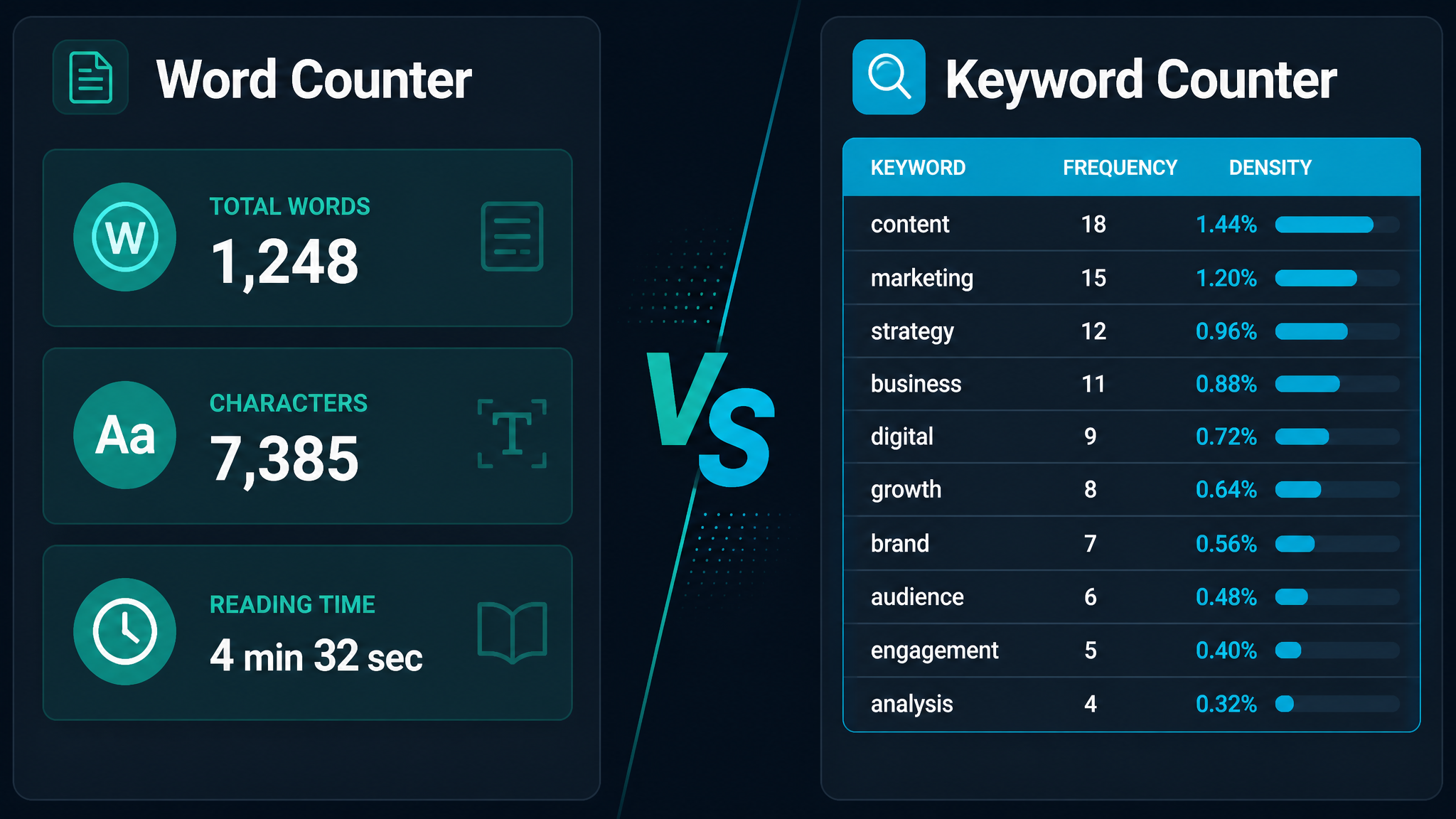
Free ebook: The Free SEO Stack
Keyword research without paying for Ahrefs — the complete guide. Read it online or download the PDF.
100% free · No spam · Unsubscribe any time
Ever caught yourself deep in the weeds of SEO, obsessing over the difference between an SEO word counter and a keyword counter? You’re not alone. It’s like picking the right kitchen gadget—do you grab the measuring cup (word counter) or the spice jar (keyword counter) first? Let’s untangle what these tools actually do, when to reach for each, and how to squeeze the most SEO juice out of them.
What Is an SEO Word Counter? (It’s Your Writing Measuring Cup)
Think of an SEO word counter as the kitchen scale for your blog: it tells you exactly how much you’ve got. Simple? Yes. But don’t underestimate it. Word count isn’t just a vanity metric. Google doesn’t hand out gold stars for verbosity, but it does tend to favour content that’s meaty enough to answer a searcher’s question properly.
Why Does Word Count Matter for SEO?
Want to take your content’s vital stats? Try the free SEO Word Counter on KeywordNumbers. No faff, no login, just paste and go.
What Is a Keyword Counter? (Your Content’s Spice Rack Inspector)
Enter the keyword counter: the tool that checks how liberally you’ve sprinkled those important terms through your text. Think of it as your content’s spice rack inspector—it’ll tell you if you’re under-seasoned or at risk of blowing someone’s head off.
Here’s where it shines:
Test your spice levels with the Keyword Counter tool. It’s fast, free, and won’t judge your choice of metaphors.
SEO Word Counter vs. Keyword Counter: Spot the Difference
Visual learner? Here’s a quick cheat sheet for the next time you’re staring at a blank page (or three tabs open):
| Feature | SEO Word Counter | Keyword Counter |
|---|---|---|
| Measures | Total word count | Frequency of specific words/phrases |
| Main Use | Checking content length | Analysing keyword usage |
| SEO Benefit | Ensures sufficient depth for ranking | Optimises for keyword balance |
| Risk If Ignored | Thin content, poor indexing | Keyword stuffing, missed opportunities |
| Example Output | 1,200 words | 'SEO' appears 15 times |
When Should You Use Each Tool? (Timing Is Everything)
Quick question: Do you check your tyre pressure before or after a long road trip? Both are smart—just at different stages. Same logic applies here:
Worked Example: How to Spy on Your Own Blog Post
Let’s walk through a real scenario. (Spoiler: no actual spying required.)
Say you’re writing a guide on ‘On-page SEO techniques’. Once your first draft is done, you run it through both tools:
Conclusion: you’re not just in the right ballpark, you’ve nailed the try line too.
Metric and Imperial Example (Because Some People Still Think in Yards)
Picture this: you’re writing a product description for a running track, and want to keep both metric and imperial fans happy.
With the keyword counter, you can check that ‘metres’ and ‘yards’ both appear enough so neither camp feels left out. It’s the international relations degree your content never had.
How to Use SEO Word Counters and Keyword Counters Like a Pro
Here’s the playbook:
Pros and Cons Table (Because Every Tool Has Its Quirks)
| Tool | Pros | Cons |
|---|---|---|
| SEO Word Counter | Quick insights into content length, easy to use | Doesn’t analyse keyword relevance |
| Keyword Counter | Pinpoints keyword usage, prevents overuse | Doesn’t show overall content length |
Questions People Are Actually Asking
How much does SEO cost?
SEO pricing is a bit like buying a car—there’s a model for every budget. For small businesses, you’re looking at anything from a few hundred to several thousand (in your currency of choice) per month. The actual figure depends on how much you want, who you hire, and how competitive your market is. No two quotes are the same—so always check what’s included.
How much does it cost for SEO?
It can be pay-as-you-go or an ongoing monthly thing. A one-off audit might be a flat fee, but if you want continuous improvements (and who doesn’t?), expect a retainer. Always ask for a breakdown—know what you’re getting so there are no nasty surprises.
How much is SEO per month?
Monthly SEO retainers often start at a few hundred (GBP, USD, EUR—dealer’s choice) and climb from there. Enterprise? You could be looking at four figures. Compare agencies, freelancers, and DIY tools to see what fits your wallet—and your goals.
How to see word counter?
Paste your draft into a word counter tool—no need to count on your fingers. The free SEO Word Counter on KeywordNumbers gives you instant answers, zero maths required.
Why is keyword counting important for SEO?
Keyword counting keeps you on the straight and narrow. Too few and Google won’t know what you’re on about. Too many and you risk a penalty. The key is balance—relevance without hammering the same word like a broken drum.
How many keywords should I use in my content?
There’s no magic number, but think quality over quantity. Use your main keyword a handful of times, plus related terms for context. If it reads naturally to a human, you’re on the right track. Shoving keywords where they don’t belong? That’s a one-way ticket to Awkwardville.
Is longer content always better for SEO?
Not always. Longer content gives you the runway to go deep, but if you’re padding for the sake of it, Google (and your readers) will notice. Stay focused, stay useful, and you’ll do just fine.
Conclusion
Here’s the bottom line: SEO word counters and keyword counters are like salt and pepper—your content needs both, but in the right proportion. Use the word counter to make sure you’re serving a proper meal, and the keyword counter to season it just so. For best results, put your draft through both tools before you hit publish.
Ready to give your content an edge? Get started with the free SEO Word Counter and Keyword Counter on KeywordNumbers. Your rankings will thank you.
Free tools to put this into practice
Reading is one thing — testing your own pages is what moves the needle. Here are the free KeywordNumbers tools that pair best with this guide:
Every one of our free SEO tools is genuinely free to use, with no sign-up required.
Free ebook: The Free SEO Stack
Keyword research without paying for Ahrefs — the complete guide. Read it online or download the PDF.
- Which free tools replace Ahrefs, SEMrush & Moz
- Step-by-step keyword research workflow
- How to find content gaps without paying a penny
- The exact stack KeywordNumbers is built on
100% free · No spam · Unsubscribe any time
Ready to research your keywords?
Try our free keyword tools — no signup required.