Website Speed vs SEO Ranking: Why Your Site’s Slow Lane Is Costing You Clicks
Print / Save as PDFInsider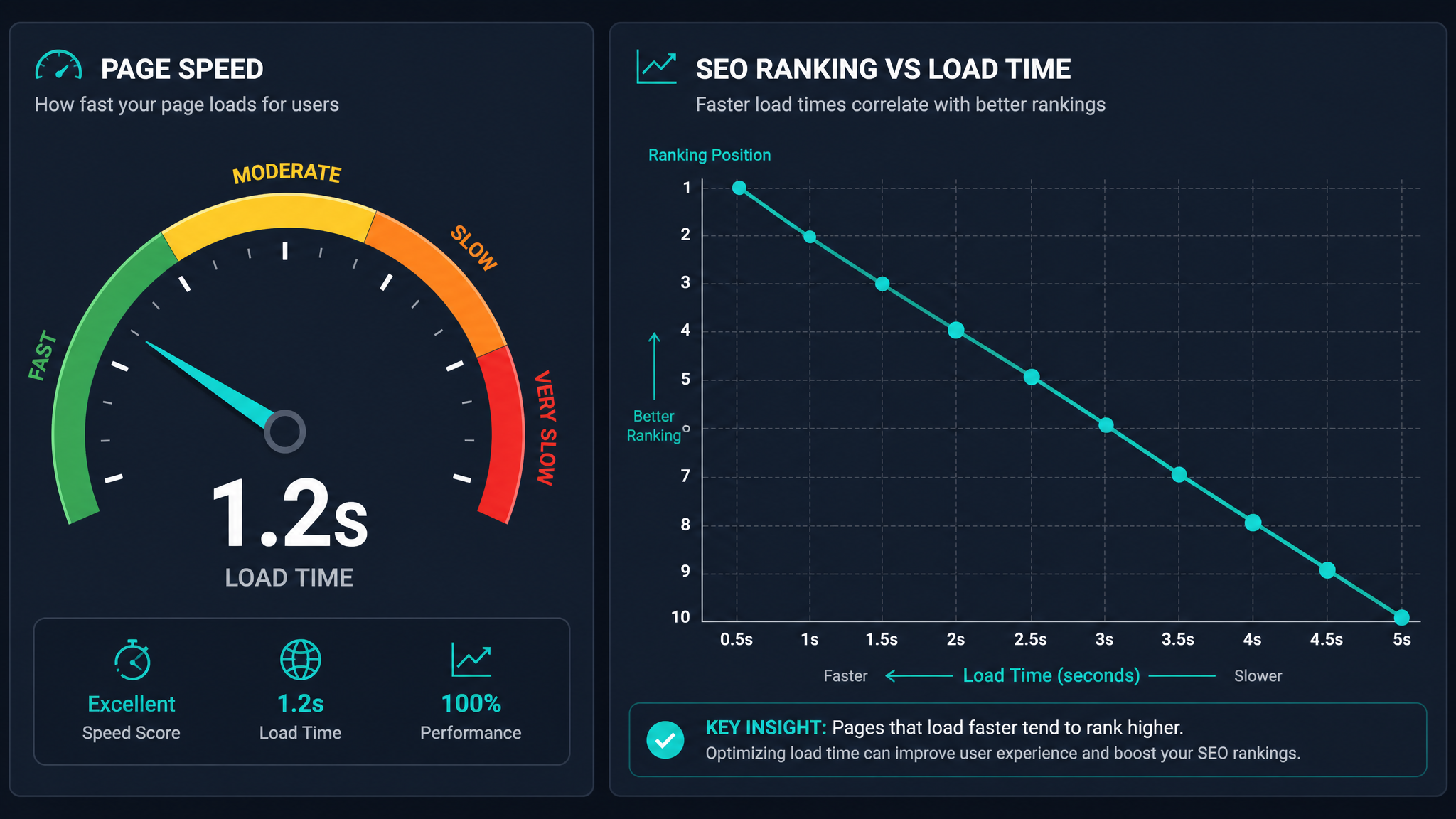
Free ebook: The Free SEO Stack
Keyword research without paying for Ahrefs — the complete guide. Read it online or download the PDF.
100% free · No spam · Unsubscribe any time
Ever wondered why your website’s stuck on page two of Google, even after you’ve sprinkled in the right keywords like SEO fairy dust? Here’s a hint: if your site loads slower than a Sunday driver in a 20 mph zone, no amount of content magic will save you. Today, we’ll unpack the real link between website speed and SEO ranking, show you how to check your site’s performance (with a free internet speed analyser), and give you genuinely actionable tips to put your site in the digital fast lane.
Website Speed vs SEO Ranking: What’s the Connection?
Let’s cut to the chase. Google’s not waiting around for your beautiful homepage to load, and neither are your visitors. Website speed is one of those rare technical factors that’s both a direct and indirect SEO ranking signal:
Think of website speed like the checkout queue at a supermarket. If it moves quickly, people stick around. But if it’s jammed up, they’ll leave their basket and bolt — probably straight to a competitor. No exceptions for “but mine’s really good.”
Why Does Google Care About Speed?
Google’s job is to deliver the best possible user experience. Slow sites are the online equivalent of dial-up internet nostalgia — not in a good way. In 2024, Google’s Core Web Vitals focus on three main things:
| Metric | What It Measures | Good Value |
|---|---|---|
| LCP (Largest Contentful Paint) | Loading performance | < 2.5 seconds |
| FID (First Input Delay) | Interactivity | < 100 milliseconds |
| CLS (Cumulative Layout Shift) | Visual stability | < 0.1 (unitless score) |
If your site flunks these, don’t expect to cruise into the top search spots.
Worked Example: Measuring Website Speed (and Why It Matters)
Let’s say you’re running a UK local business site. You test your homepage with a free website speed analyser and see results like this:
Now, compare that to your competitor:
That’s a difference of 2.7 seconds, or about the time it takes to lose a visitor’s attention (and their business). In US terms, that’s roughly 4MB vs 1.5MB, and 65 requests is like serving up a full five-course meal instead of a quick sandwich. Guess which one Google — and your customers — will prefer?
How to Analyse Your Website’s Speed
Here’s what most people miss: it’s not just your internet connection; it’s your actual web hosting, page code, and images that slow things down. To get a clear reading:
If you’re above 2.5 seconds for load time or have page sizes over 2MB, it’s time for a tune-up.
Practical Tips to Boost Both Speed and SEO Ranking
Bet you didn’t realise: shaving a second off your load time can make a bigger difference to rankings than a month’s worth of new blog posts (assuming you’re not already lightning-fast).
Here’s how to get your site off the SEO hard shoulder:
Want a before-and-after feel? Run a quick speed test before and after each tweak to see the impact. Real numbers, real progress.
How Website Speed Compares to Other SEO Factors
Speed isn’t the only thing Google looks at, but it’s like the tyres on a race car — without it, you’re not going anywhere fast, no matter how shiny the paint. Here’s a quick comparison:
| SEO Factor | Direct Impact | Indirect Impact | How Speed Stacks Up |
|---|---|---|---|
| Keywords | Yes | Yes | Needed, but not enough alone |
| Backlinks | Yes | Yes | Only help if site is usable |
| Content Quality | Yes | Yes | Slow content gets ignored |
| Website Speed | Yes | Yes | Essential for all the above |
In short: you need all four, but speed is the foundation. Don’t skip it.
Questions People Are Actually Asking
What is internet ranking SEO?
Internet ranking SEO refers to where your website appears in search engine results for relevant keywords. A higher ranking means more visibility, more clicks, and (if you’ve done your homework) more business. It’s the digital version of having your shop on the high street instead of down a dark alley.
What is an SEO ranking?
SEO ranking is your website’s position on the search engine results page (SERP) for a given keyword or phrase. Ranking #1 means you’re top dog for that search. Ranking #10? Well, you’re still on the pitch — but barely.
How to increase website ranking with SEO?
Focus on three things: technical SEO (like improving website speed with a speed test), high-quality content, and earning quality backlinks. Regularly update your site, use relevant keywords naturally, and make sure your pages load fast for both users and search engines.
How to check your website SEO ranking?
Use SEO tools like Google Search Console, SEMrush, or Ahrefs to track your keyword positions. For a free-and-quick snapshot of how your site’s speed might be affecting your rankings, try a website speed analyser — slow load times can drag your rankings down.
How to increase SEO ranking?
Speed up your site, optimise content for relevant keywords, earn backlinks from reputable sources, and improve user experience across all devices. Don’t forget technical fixes: mobile-friendliness, clear navigation, and fast load times are all winners in Google’s eyes.
What is a good SEO ranking?
A “good” SEO ranking depends on your goals — but for most, it means appearing on the first page of Google (positions 1-10). Aim for the top three spots for the keywords that matter most to your business. Anything past page two is, frankly, the digital equivalent of shouting into the void.
Conclusion: Speed Up, Rank Higher
Website speed isn’t just a technical detail; it’s the starting pistol for your entire SEO race. If your site’s stuck in the slow lane, you’re handing clicks (and customers) to your competitors. Give your site a health check with our free internet speed analyser, see where you stand, and start making those changes. Your future rankings — and your visitors — will thank you.
Free tools to put this into practice
Reading is one thing — testing your own pages is what moves the needle. Here are the free KeywordNumbers tools that pair best with this guide:
Every one of our free SEO tools is genuinely free to use, with no sign-up required.
Free ebook: The Free SEO Stack
Keyword research without paying for Ahrefs — the complete guide. Read it online or download the PDF.
- Which free tools replace Ahrefs, SEMrush & Moz
- Step-by-step keyword research workflow
- How to find content gaps without paying a penny
- The exact stack KeywordNumbers is built on
100% free · No spam · Unsubscribe any time
Ready to research your keywords?
Try our free keyword tools — no signup required.